
Hail Dent Repair: Methods, Costs and Insurance Explained
Hail Dent Repair: Methods, Costs and Insurance Explained

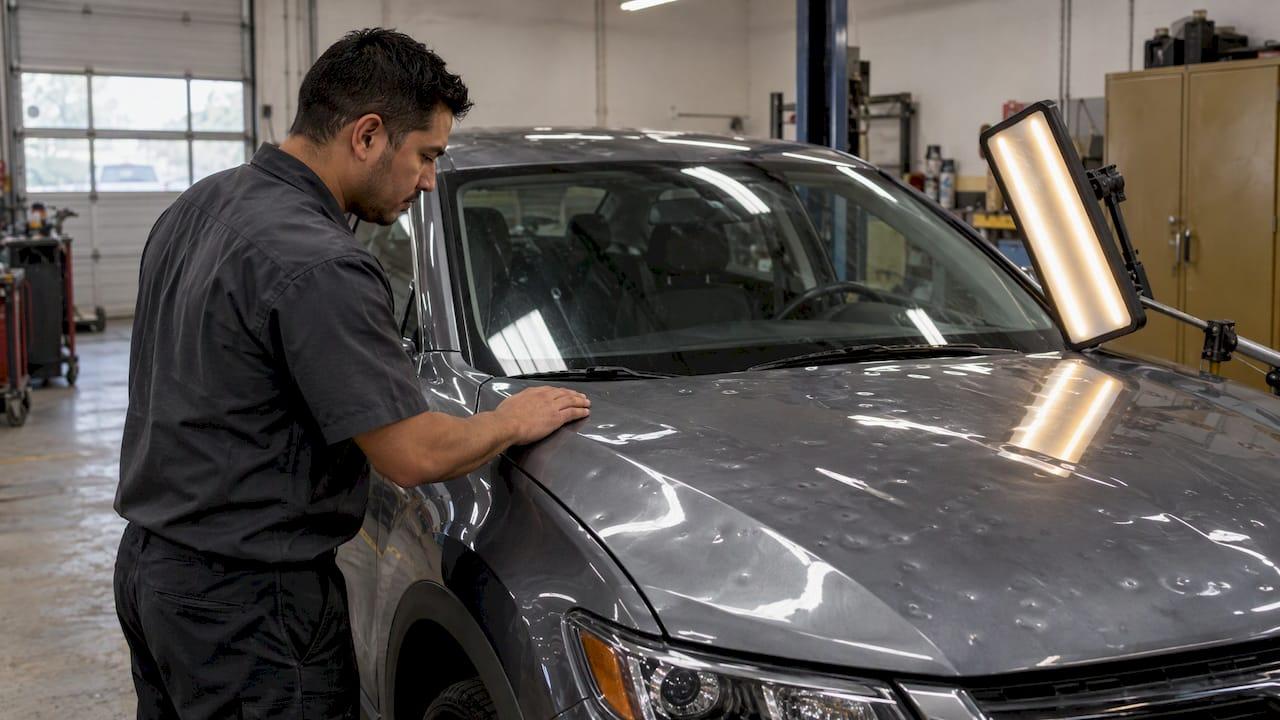
Hail dents are fixed one of two ways: technicians either push the metal back out from behind the panel without touching the paint, or they pull the dent, fill it, prime it and repaint the area. Which route fits depends on how deep the dents are, where they sit and whether the paint has cracked. Insurance usually pays through comprehensive coverage, minus your deductible. Below, we walk through the methods, the claim, the resale question and what to look for in a shop.
TL;DR
-
Shallow hail dents with intact paint can often be pushed out from behind the panel. Deep dents or cracked paint usually call for conventional repair and refinishing.
-
Hail is generally a comprehensive coverage claim, not a collision claim, and your deductible comes off the payout.
-
A hail claim in vehicle-history reports can affect resale perception, so a clean, factory-matched finish matters.
-
You choose where the car is repaired. Get a written estimate before you commit, and compare it with the insurer’s.
-
Dent pulling kits from the hardware store take patience and a light hand. Large or deep hail damage is a job for a shop.
Table of Contents
How hail dents are fixed
There are two professional methods, and a good estimate names which one applies to each panel.
Paintless dent repair (PDR). According to Nationwide’s hail damage guidance, PDR uses specialized tools on the underside of the panel to push out and smooth dents without disturbing the painted surface. The National Alliance of Paintless Dent Repair Technicians describes it as patient massaging from the back of the panel, with no grinding, filler, primer or repainting.
Conventional repair. The same Nationwide page explains that this approach pulls the dent out, fills irregularities, then primes and repaints the repaired area. It is the better fit for deep dents. When the metal is badly stretched or the paint has failed, there is no way around refinishing, and the quality of that refinishing decides how the car looks for years afterward.
In practice, one hail-damaged car often needs both. A roof full of shallow dimples may be a different job from a hood with a few sharp, deep hits.

What else hail damages
Panels are only part of it. AAA lists the usual post-hail repairs as dent removal where the paint is intact, repainting for chipped or cracked paint, windshield replacement, and replacement of rear or side glass and side mirrors. Walk around the car in daylight and photograph the roof, hood, trunk, glass, mirrors and trim before you call anyone.
Paintless or conventional: how the call gets made
No one can judge this from a phone photo. The NAPDRT consumer page says depth and location both matter. A dent the size of a dinner plate may be fixable if it is not too deep, while a small but very deep dent may not be, because the metal has stretched. Cracked paint is a sign that a dent is probably too deep for PDR.
Here is a plain way to think about it:
| What you see | Likely route |
|---|---|
| Shallow dimples, paint intact | Pushing the metal out from behind |
| Deep, creased or sharp dents | Pulling, filling and refinishing |
| Chipped or cracked paint over a dent | Refinishing the panel |
| Dents along a body line or panel edge | Depends on access and metal stretch |
| Panel too damaged to straighten | Panel replacement and paint |
Nationwide notes that the repair facility can recommend which method suits the damage. That is the right order of operations: have the car looked at in person, then decide.
What hail dent repair costs
The cost depends on dent count, panel size, depth and whether paint work is involved. Instead of quoting a national average that may not match a New Jersey shop, here are the two things that hold up.
First, NAPDRT says PDR’s main benefits include preserving factory paint, avoiding filler shrinkage, and costing roughly one-quarter to one-third of conventional dent repair where it applies. It also says hail repairs by PDR typically take a day, against two to three weeks for body-shop work. Those are the trade-offs a technician weighs against dent depth.
Second, the number that matters most to you is the one on a written estimate for your car. Every shop prices from a count of dents per panel, which is why two estimates for the same car can differ. At Leslie’s we do not publish repair prices, because a price without seeing the car would be a guess. We give free estimates with no obligation and without starting a claim.

How insurance handles hail damage
Most hail questions are really deductible questions.
Which coverage applies
AAA says hail damage is generally covered by comprehensive insurance, not collision or liability. That is worth checking on your declarations page. If you carry only liability, hail damage to your own car is not covered.
How the deductible works
Allstate’s catastrophe claims document defines comprehensive as protection for non-collision events including hail, with payment up to the vehicle’s actual cash value minus the deductible. Its example: a $4,500 covered claim with a $500 deductible produces $4,000 from the insurer. The same document says the deductible is the part of a covered loss you are responsible for, and that in most cases you pay it to the repair facility after the repair.
AAA adds that a deductible can be higher than the repair cost, which leaves you paying out of pocket anyway. When your estimate is close to your deductible, get the estimate first. Then decide whether a claim makes sense.
Report promptly
AAA advises reporting damage promptly, and filing deadlines vary by provider. Check your own policy or call your agent for your window.
When the insurer’s estimate looks light
This is common after a hailstorm, when adjusters are busy. NAPDRT’s hail claim guide says an insurer’s estimate may specify PDR, conventional repair or a mix. Severe damage may need panel replacement, and the shop can notify the insurer when the estimate uses the wrong repair type or is too light. If your estimate and the shop’s do not match, that is a conversation to have through the shop, with photos and line items, not a reason to accept less repair than the car needs.
Choosing your own shop
Your insurer may hand you a short list of “preferred” shops. That list is a convenience for the insurer. As we explain it to customers in New Jersey, you have the right to choose the shop that repairs your car. The condition on our site is that the shop must accept the insurer’s most generous terms, and a signed notice comes first. If you are weighing a referral against a shop you picked yourself, our insurance claim help page lays out how the process runs.
Leslie’s is an independent shop. We are not a direct repair program shop for any insurer, and we are not partnered with, preferred by or approved by any carrier. We assist with claims from major carriers, and our repair decisions are made for the car owner.
Does repaired hail damage lower resale value?
It can. Family Handyman, citing Carfax data, reports that repairing hail damage lowers retail value by $500 to $2,100, while leaving the damage unrepaired can cost as much as the repair itself or more. A hail-repair industry blog adds that even a professional repair can affect buyers’ perception when a claim shows in a vehicle-history report.
What you control is the quality of the work. Three habits help:
-
Keep the paperwork. An itemized invoice listing each panel and the method used shows a buyer exactly what was done.
-
Photograph before and after. Dated photos back up the invoice.
-
Insist on a matched finish. Where a panel is refinished, color match and blend decide whether anyone can tell. Our auto painting and color matching work is aimed at factory-standard results.
If you drive a lease, read the return terms. Excess-wear charges often turn on visible dents and mismatched paint, so a clean repair before turn-in matters.
Can you fix hail dents yourself?
Sometimes, in small doses. Family Handyman says pulling kits can give good results, but they demand a gentle hand and repeated, small applications of pressure. The same article says heat-and-cool tricks have mixed results, and too much heat can damage paint. Pushing and pulling tools need careful, incremental pressure and finesse.
A realistic summary: a single small dent on a flat panel with intact paint is a fair practice project. A hood, roof and trunk covered in dents, or any dent with cracked paint, is not. A stuck-on puller can lift paint, and a mistake turns a repairable dent into a refinishing job. If you are filing a claim, also keep the damage untouched until the estimate is done, so the adjuster and shop see the same car.
What to ask a shop about hail repair
Use these questions at any shop, including ours.
-
Who does the work? AAA suggests asking whether someone on staff is trained in PDR. If the answer is a different specialist, ask who and how the work is handled.
-
What is the written scope? DentAdvisor’s checklist for checking technician credentials recommends getting the scope in writing, along with verifying training, licensing and insurance, and reading reviews on more than one platform.
-
What happens if the dent count changes? Hidden dents often show up once panels are cleaned or lit properly. Ask how supplements are handled.
-
How is the paint matched? For any refinished panel, ask how color is matched and blended into neighboring panels.
-
What are the warranty terms? Ask for them in writing, with what is covered and for how long.
-
How is the insurer handled? Ask who communicates with the adjuster and who gets the check.
How a hail repair runs at our shop
We are an independent collision repair shop at 908 King Georges Post Rd in Fords. Here is the usual sequence for a hail-damaged car.
-
Free estimate. Bring the car in. We inspect every panel, count and mark damage, and give you a written estimate. It carries no obligation and does not start a claim.
-
Plan the repair. We explain which panels need dent repair, which need refinishing and whether glass or trim is involved.
-
Claim support. If you are filing, we help with the paperwork and documentation and work with your carrier. Our claim assistance covers all major carriers.
-
Repair and refinish. Dents are worked out, panels are refinished and color is matched to factory standards.
-
Finish and detail. The car goes home finished, not half done.
For bigger events, such as a tree limb falling during the same storm, the damage can reach beyond dents. Our collision repair and frame and structural repair services cover that case.
Perspective from the shop floor
Hail claims are where the gap between the insurer’s priorities and the owner’s shows most. An insurer wants the claim closed fast and cheap. You want the car to look the way it did before the storm, and to sell for what it should.
That is why we never signed up to be a direct repair shop. Working at the mercy of an insurance company means the repair plan starts with someone else’s budget. We start with the car. We look at each panel, write down what it needs, and tell you plainly.
If the insurer’s estimate does not cover what the car needs, we help document that. If your deductible is more than the repair, we tell you that too, and you decide how to proceed. Our job is the finish: dents out, paint matched, car back to you in the condition it left your driveway.
Robert De La Cruz
Get your hail damage looked at
If your car took hail damage, the most useful next step is a free, no-obligation estimate. We will go panel by panel, explain what the repair involves and help you line it up with your claim if you decide to file. See our dent and bumper repair page for how we handle dents, or start from our Fords shop page.

If you are in Perth Amboy or Metuchen, our Perth Amboy and Metuchen pages cover the same services from the same Fords shop.
FAQ
How are hail dents fixed on cars?
Shallow dents with intact paint can be pushed out from behind the panel with specialized tools. Deeper dents are pulled, filled, primed and repainted. A shop inspection tells you which route each panel needs, and a single car often needs both.
Does insurance cover hail damage?
Generally yes, if your policy includes comprehensive coverage. Collision and liability coverage do not typically pay for hail. The insurer pays the repair cost minus your deductible, and if the deductible is higher than the repair, you pay the whole repair yourself.
Does repaired hail damage lower a car’s value?
It can. Carfax data cited by Family Handyman puts the drop at $500 to $2,100 for repaired hail damage, and a claim in a history report can affect buyer perception. An itemized invoice, before-and-after photos and a color-matched finish help you show the work was done well.
Do dent pullers really work on hail dents?
On a small, shallow dent they can, if you use gentle, repeated pulls. Heat methods are hit or miss and too much heat can damage paint. Widespread hail damage or cracked paint is better handled by a shop.
Can I choose my own body shop after a hail claim?
Yes. Your insurer may suggest a shop, but the choice is yours. The condition we explain on our site is that the shop must accept the insurer’s most generous terms, and a signed notice comes first.